miércoles, 7 de marzo de 2018

Deuda estadounidense / Inflación: la Fed como herramienta de apoyo a los objetivos de Trump. GEAB núm 122

Deuda estadounidense / Inflación: la Fed como herramienta de apoyo a los objetivos de Trump

pic geab 122
A principios de febrero, las bolsas estadounidenses y, subsecuentemente, el resto de los mercados financieros del mundo, experimentaron una brutal corrección. En solo dos días, el índice Dow Jones perdió sus beneficios del mes de enero y se adentró en una espiral descendente. Desde entonces, el mundo financiero se tambalea. Aunque esta corrección ha mantenido una dinámica propia, principalmente por efecto de los nuevos productos derivados de volatilidad, su punto de partida fue la publicación, el 2 de febrero, de la progresión en enero del crecimiento de los salarios por hora, que aumentaron un 2,9 % después de aumentar un 2,6 % en diciembre[1]. Una aceleración que amenaza al mercado con traer una restricción monetaria antes de lo que se espera en EE. UU. y, como consecuencia, también una desaceleración del crecimiento económico. Dado que, después de nueve años de subida continua – una de las más prolongadas de la historia de Wall Street – el mercado estadounidense comienza a sobrevalorarse[2], todo análisis de crecimiento a la baja se traduce automáticamente en beneficios masivos.
Tras haber deseado durante mucho tiempo que volviera la inflación, los mercados ahora la temen. O, mejor dicho, temen que no traiga consigo una aceleración de la restricción monetaria[3]. La corrección del mercado financiero es una advertencia para el nuevo presidente de la Reserva Federal Estadounidense, Jerome Powell, que relevó a Janet Yellen el 5 de febrero[4]: toda determinación a acelerar la normalización de los tipos podría traducirse en un crac bursátil. El sector financiero reconoce que la euforia pasada depende del dinero fácil y así, el nuevo presidente de la Fed está obligado a mantener la política de Janet Yellen: avanzar hacia la normalización sin prisa, pero sin pausa.
Jerome Powell bajo la presión de los “halcones”
¿Qué hará Jerome Powell? De entrada, efectivamente corre el riesgo de encontrarse atrapado bajo la presión de los “halcones” de la Fed. De hecho, uno de los principales argumentos para la prudencia de Janet Yellen está a punto de caer. La Fed posee un doble cometido: asegurar el pleno empleo y estabilizar la inflación en torno al 2 %. Aparentemente, el primer objetivo ya se ha alcanzado: la tasa de desempleo, al 4,1 %, se acerca a los mínimos históricos[5]. Pero este pleno empleo aún no se traduce en una subida de los precios. Es cierto que la inflación llegó en diciembre al 2,1 %, pero la inflación subyacente, aquella que no tiene en cuenta la energía y la alimentación, permanece al 1,8 %. Y, lo que es más importante, nada garantiza la sostenibilidad de la dinámica inflacionista mientras no se instaure una dinámica precios-salarios. No obstante, los salarios continúan aumentando muy moderadamente. En 2017, la inflación sufrió así una brusca desaceleración, volviendo a descender entre mayo y agosto por debajo del 2 %[6].
Es esto lo que justificaba, a los ojos de Janet Yellen, su prudencia. En noviembre se declaró “perpleja” ante la ausencia de la espiral precios-salarios[7]. Y durante la última reunión del Comité de Política Monetaria presidida por ella, el 31 de enero, mantuvo su posición de una subida moderada de los tipos, respaldada por todos los demás miembros[8]. Pero desde que al fin se está perfilando una dinámica salarial y la reducida tasa de desempleo se traduce en un aumento de los salarios, la Fed tiene razones para pensar que la ansiada espiral precios-salarios está a punto de hacerse realidad. Los “halcones” de la Fed están empezando a abogar abiertamente por una aceleración de la restricción monetaria. El 2 de enero, Neel Kashari, presidente de la Reserva Federal de Minneapolis, no dudó en advertir de que “si el crecimiento salarial continúa, podría afectar al ritmo de subida de los tipos”[9]. Prevista para marzo, la próxima reunión del Comité de Política Monetaria de la Fed debería ser la ocasión para aumentar los tipos. Y esta primera reunión presidida por Jerome Powell también será la ocasión para determinar si se inclina por la continuidad o se posiciona del lado de los halcones.
La pérdida de independencia de la Fed
El nuevo presidente de la Fed podría sin embargo basar sus decisiones no tanto en la presión de los mercados o de los halcones, sino en el apoyo que pretende dar a la política económica de Donald Trump. Jerome Powell es claramente “el hombre del presidente”. Jurista de profesión (no economista), en teoría tenía muy pocas posibilidades de ocupar la Presidencia del banco central más poderoso del mundo[10]. Es gobernador de la Fed tan solo desde 2012 y será el primer presidente no economista de la Reserva Federal desde 1979. Es decir, si la elección de Donald Trump se zanja. Y si el sentimiento de reconocimiento de Jerome Powell es fuerte[11].
Durante el anuncio en noviembre del nombramiento de Jerome Powell, este fue aclamado como seguidor de los pasos de Janet Yellen, pues en la Fed, tenía reputación de “centrista” en materia de política monetaria[12]. Pero en realidad, Donald Trump lo ha designado por apoyar su política. El presidente estadounidense fue parco en reproches hacia la Fed durante su campaña. Más adelante se mostró más discreto aún e incluso en ocasiones, elogioso, aunque había descartado a Janet Yellen para un segundo mandato, rompiendo con la tradición. Esta última no ha podido ocultar su decepción, dimitiendo al término de su mandato[13]. ¿Por qué no conservar a Janet Yellen si el objetivo era continuar con la misma política? Muchos han advertido discrepancias entre Donald Trump y Janet Yellen sobre la regulación. Es probable, pero sobraban motivos para discrepar, empezando por el gran plan de reducción de impuestos[14].
Con Jerome Powell, es altamente probable que la Fed pierda aún más independencia. Y, paradójicamente, esta pérdida podría traducirse efectivamente en una continuación de la política de Janet Yellen. Por el momento, el presidente estadounidense no tiene ningún interés en que los tipos asciendan. Ha prometido que su política económica – en particular fiscal – se va a traducir en un crecimiento del 4 % este año. Una estimación muy ambiciosa para alcanzar la cual será necesario descartar toda política de restricción monetaria rápida. Máxime cuando su política se va a traducir en un dramático aumento del déficit público estadounidense de 1,5 billones de dólares en 10 años[15]. El presidente estadounidense podría tratar de mantener los tipos reales bajos, en aras de reducir el coste real de este déficit…
Para leer más: GEAB 122
———————————————————————————-
[1] Fuente: New York Times, 02/02/2018
[2] Fuente: Forbes, 24/01/2018
[3] Fuente: USA Today, 02/02/2018
[4] Fuente: New York Times, 05/02/2018
[5] Fuente: Reuters, 04/02/2018
[6] Fuente: Bloomberg, 13/12/2017
[7] Fuente: Reuters, 22/11/2017
[8] Fuente: Bloomberg, 31/01/2018
[9] Fuente: Wall Street Journal, 02/02/2018
[10] Fuente: New York Times, 02/11/2017
[11] Fuente: Morningstar, 03/11/2017
[12] Fuente: Reuters, 07/11/2017
[13] Fuente: Politico, 20/11/2017
[14] Fuente: Bloomberg, 13/11/2017
[15] Fuente: Wall Street Journal, 09/02/2018

Anticipating the future of the GEAB

Dear readers,

The GEAB team is currently working towards a makeover for our website and bulletins with a view to creating a new product, which we hope will fit better with your wants and needs. To help us with this task and to involve you more in our privileged community, we have put together the following for, which we would be very grateful if you could complete.

It should not take more than 3 minutes and it is available in 4 languages, see below the direct links.

English
<http://www.leap2020.net/newsletter/lt.php?id=Mh8GBgFYTwtVXh4DBgQBBw>
/ Français
<http://www.leap2020.net/newsletter/lt.php?id=Mh8GBgZQTwtVXh4DBgQBBw>
/ Italiano
<http://www.leap2020.net/newsletter/lt.php?id=Mh8GBgZRTwtVXh4DBgQBBw>
/ Espanol
<http://www.leap2020.net/newsletter/lt.php?id=Mh8GBgZTTwtVXh4DBgQBBw>

Thank you so much in advance for your time !

GEAB by LEAP

---------------------------------------------------------------------------------------

Global Europe Anticipation Bulletin, your crisis time companion
<http://www.leap2020.net/newsletter/lt.php?id=Mh8FBQNRTwtVXh4DBgQBBw>

lunes, 26 de febrero de 2018

2018/02/23 - Natural gas sets the stage for an armed conflict in the East Mediterranean. Gefira Financial Bullletin 21

Source: shutterstock.comNatural gas sets the stage for an armed conflict in the East Mediterranean

The efforts of individual countries to access the gas fields in the south-eastern part of the Mediterranean make the area very vulnerable to new conflicts and war and can also lead to a dispute within NATO and affect Europe’s energy security, putting the EASTMED pipeline in question. The war for natural resources is looming large.
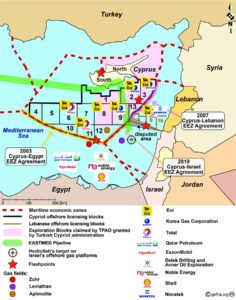
The first problem is the relationship between Cyprus and Turkey. Ankara, the only capital which recognizes North Cyprus, says that all activities related to the extraction of gas in the Cypriot area are an encroachment on the interests of North Cyprus. While Turkey does not recognize agreements between Cyprus and other countries on the issue of economic exclusive zone (EEZ) or licenses for gas exploration in Cypriot territorial waters, Nicosia holds the opposite opinion. Ankara, through the Turkish Petroleum Corporation (TPAO) puts forward claims that it is entitled to look for gas and oil in Cypriot waters and has the right to defend its interests there. Cyprus issued a number of concessions to various mining companies on more than half of the blocks (i.e. parts of the economic exclusive zone on which companies could explore gas or oil) located within the Cypriot EZZ. President Erdoğan warned Cyprus and international gas exploration companies that the violation of Turkish interests would have bad consequences.1)Erdogan warns Greece, Cyprus over gas search, Aegean islets, ABC News 2018-02-13. In the middle of February 2018 the warning was made good and so the Saipem 1200 mining vessel operating for Italian company – Eni was blocked by Turkish ships. Italy responded by sending a military ship to the area.2)Italy sends frigate to Cyprus’s EEZ, Ekathimerini 2018-02-13. This shows how explosive the situation is now that two NATO member states want to pursue economic goals without backing them with diplomacy.

It is worth mentioning that also in February a Turkish coast guard boat rammed a Greek patrol ship in the Aegean Sea,3)Greece says won’t tolerate border challenges after Turkish collision, Reuters 2018-02-15. which shows that the Turkish government is willing to use military force.
The deepening cooperation between Cyprus, Greece, Israel and Italy regarding the EastMed gas pipeline project4)Greece, Cyprus, Italy, Israel sign MoU for East Med gas pipeline, New Europe 2017-12,05. is another flashpoint. The new pipeline, whose aim will be to supply gas from the Caspian Sea to Southern Europe, would weaken the transit role of the Turkish TANAP.
Another potential conflict is the one between Turkey and Egypt over the rich Zohr gas field discovered only in 2015. Ankara does not recognize the 2003 Cypriot-Egyptian EEZ accords and the 2013 sea border agreements between Cairo and Nicosia, which assign the Zohr gas field to Egypt.5)Egypt defends Cyprus gas deal after Turkey criticism, Daily Mail 2018-02-08. 6)Egypt rejects Turkey’s stance on Cyprus demarcation agreement, Energy Egypt 2018-02-09. At the beginning of February 2018, the Egyptian government warned Turkey that further interference in this area would be met with a decisive reaction.7)Egypt warns Turkey over eastern Mediterranean economic interests, Reuters 2018-02-07.
The relations between Turkey and Egypt are already strained. Though Turkey was a supporter of the Egyptian Brotherhood and Mohamed Mursi, who took power in Egypt in 2011, nowadays there is no love lost between Ankara and Cairo, because in 2013 the Trukey-friendly government was toppled. In a 2016 interview, President Erdoğan gave vent to his anger, calling the current Egyptian President Abdel Fattah al-Sisi, a “putschist” who killed thousands of his own people.8)Erdoğan blasts Egypt’s ‘putschist president’ Sisi in al-Jazeera interview, Al Araby 2016-07-22.
The sea area between Israel and Lebanon is the most explosive area, which extends along the edges of three Lebanese gas exploration Blocks: 8, 9, 10 of which Block 9 is said to be the most profitable and is claimed by Israel. In the first half of February 2018, Lebanon signed a contract for exploratory and production works with Italian Eni, French Total and Russian Novatek.9)Risking Israeli dispute, Lebanon signs deal with 3 oil firms, The Washington Post 2018-02-09. Since the works are to be carried out in Block 9,10)Lebanon to begin offshore energy search in block disputed by Israel, Reuters 2018-02-09. Israel described Lebanon’s action as “very provocative”,11)Israel, Lebanon argue over offshore energy block, Cyprus Mail, 2018-01-31. paving the way for a military showdown. In response to it, the Hezbollah leader Hassan Nasr Allah threatened to target Israeli offshore gas platforms.12)Hezbollah threatens Israeli offshore gas rigs with missiles, Ynetnews 2018-06-02.
The Israeli media are already speculating about the third Lebanese war and suggest that the Hezbollah attack on Israel is inevitable.13)Rockets, missiles and more: predicting the third Lebanon war, Jeruselem Post 2018-02-09. In mid-February, US Secretary of State Rex Tillerson declared that Washington could help resolve the dispute between Israel and Lebanon, but Hasan Nasr Allah refused to have talks with the United States, a dishonest broker. Hezbollah is supported by Iran as is Lebanon by Turkey. Tel Aviv accuses Ankara of supporting Hamas, while Turkey says it merely defends Islam and Palestinians.14)Turkey rejects Israel’s claim Ankara helps Hamas, The Jerusalem Post 2018-02-15. The presence of Israeli troops in Cyprus is perceived by President Erdoğan as interference in the Turkish sphere of influence. It was in June 2017 that Israeli commandos carried out the largest military exercises so far, aimed at counteracting a possible annexation of Cyprus by Turkey.15)Israeli Commandos Heading to Cyprus for Largest-ever Drill, Haaretz 2018-02-15.
Gas deposits in the Eastern Mediterranean attract the attention of European, Russian, Iranian, Turkish and American armed forces. Cyprus occupies here a strategically important place. The number of players is a sum of the countries directly involved and their allies. Gas, like crude oil, has the potential of igniting a new wave of violent encounters between enemies and friends.
1.Erdogan warns Greece, Cyprus over gas search, Aegean islets, ABC News 2018-02-13.
2.Italy sends frigate to Cyprus’s EEZ, Ekathimerini 2018-02-13.
3.Greece says won’t tolerate border challenges after Turkish collision, Reuters 2018-02-15.
4.Greece, Cyprus, Italy, Israel sign MoU for East Med gas pipeline, New Europe 2017-12,05.
5.Egypt defends Cyprus gas deal after Turkey criticism, Daily Mail 2018-02-08.
6.Egypt rejects Turkey’s stance on Cyprus demarcation agreement, Energy Egypt 2018-02-09.
7.Egypt warns Turkey over eastern Mediterranean economic interests, Reuters 2018-02-07.
8.Erdoğan blasts Egypt’s ‘putschist president’ Sisi in al-Jazeera interview, Al Araby 2016-07-22.
9.Risking Israeli dispute, Lebanon signs deal with 3 oil firms, The Washington Post 2018-02-09.
10.Lebanon to begin offshore energy search in block disputed by Israel, Reuters 2018-02-09.
11.Israel, Lebanon argue over offshore energy block, Cyprus Mail, 2018-01-31.
12.Hezbollah threatens Israeli offshore gas rigs with missiles, Ynetnews 2018-06-02.
13.Rockets, missiles and more: predicting the third Lebanon war, Jeruselem Post 2018-02-09.
14.Turkey rejects Israel’s claim Ankara helps Hamas, The Jerusalem Post 2018-02-15.
15.Israeli Commandos Heading to Cyprus for Largest-ever Drill, Haaretz 2018-02-15.

2018/02/22 - When fact-checkers fail: an answer to Sara Pellegatta of the Soros-funded Atlantic Council. Gefira.

Source: shutterstock.comWhen fact-checkers fail: an answer to Sara Pellegatta of the Soros-funded Atlantic Council

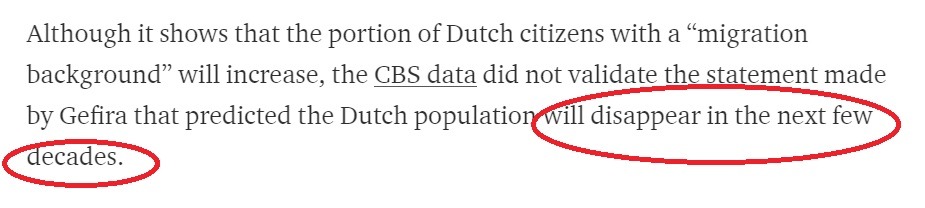
Further in the article she compares a study by the Dutch statistic agency (the CBS) with ours, making a similar assessment:At no point in our article on the Dutch demographics do we claim that “the Dutch population will disappear in the next few decades”. We state: “Cerberus on the other hand shows that in 2015 the Dutch population started to decline rapidly and in 2060 there will be 12 million Dutch left while at the end of the century there will only be 9 million native Dutch.3)Cerberus 2.0 predicts with scientific precision the disappearance of the Dutch population, Gefira 2017-06-05.
Our analyses on the Dutch and Italian demographics recently went under “fact-checking” by Sara Pellegatta1)#ElectionWatch: Murky Metrics in Italian Migration Debate, Medium 2018-02-07. of the “Digital Forensic Reseach Lab” of the Atlantic Council.
Mrs. Pellegatta’s claim is that our analyses were “murky” and “controversial”, going on to discuss the impact they’d have on the immigration debate in the upcoming Italian elections. We are open to address her concerns:
  • she opens by stating that we claim that Italians will be soon a minority within their own country.

Our study says it will be around 2080.2)The incredibly shrinking Italian population: by 2080, Italians will be a minority within their own country, Gefira 2018-01-18. Now, while “soon” does not have a specific quantification, 2080 is not exactly around the corner. Her statement is rather distorting.
Unlike the previous preferred wording, this one is simply false. “Minority by the end of the century”, our claim, does not match what Mrs. Pellegatta claims in her article “will disappear in the next few decades”.
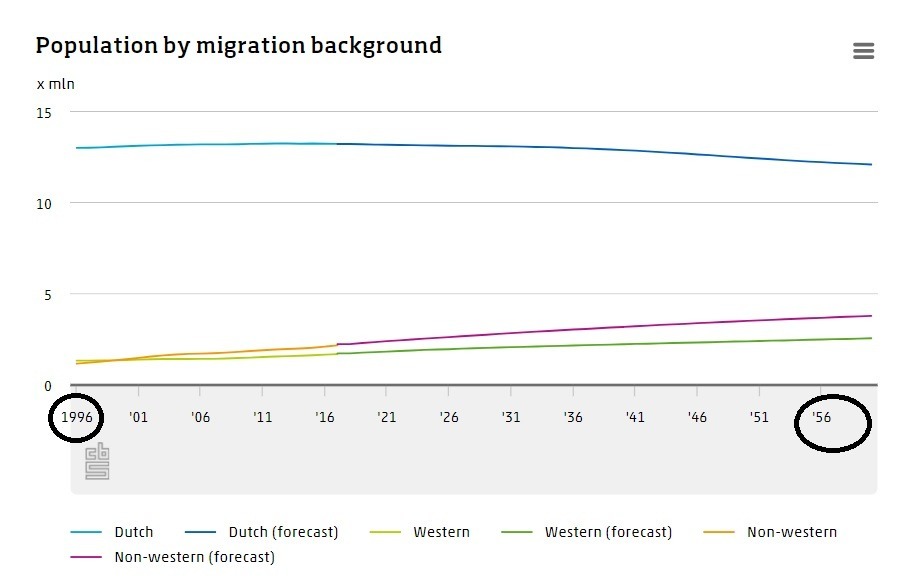
She further claims that the CBS study disproves our projection. Let’s put both side by sideAbove is the CBS study, making a projecting starting in 1996 and ending slightly after 2056, in 2060.
The estimate of the CBS is that by 2060, the total population in the Netherlands will be between 17.2 million and 19.7 million, and that “over the next few decades, the population of the Netherlands will grow solely on account of migrant arrivals, against a decline in the number of native Dutch inhabitants. As of 2017, 23 percent of the population have a western or non-western migration background. This share is expected to reach 34 percent by 2060″.
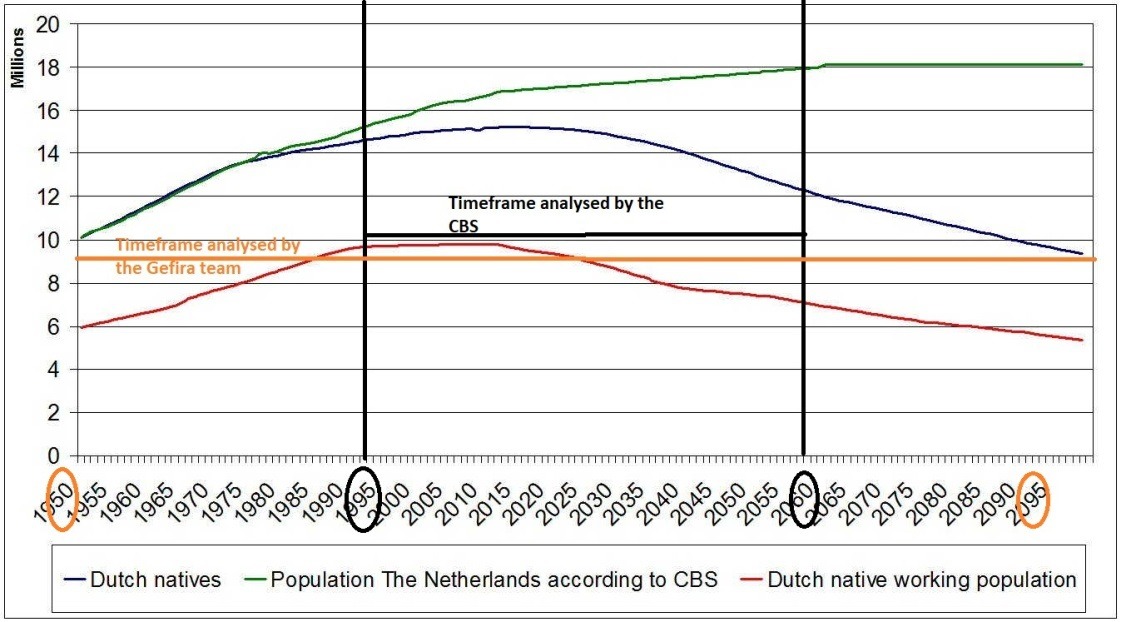
Let’s compare those numbers with our projection:As the chart above shows, our projection focused on a longer time frame, from 1950 to after 2095.
For the segment analysed by the CBS, starting in 1996 and ending in 2060, our analysis predicts:
  • A total population in the Netherlands of roughly 18 million by 2060, which is in line with the fork 17.2-19.7 projected by the CBS.
  • A native Dutch population of roughly 12 million (the CBS chart says 12.09) and a population with migrant background of roughly 6 million. Basic maths says that 6 million out of 18 is 33%, very close to the 34% claimed by the CBS for 2060.
The numbers posted by the CBS are very close to ours, within the standard deviation error. Mrs. Pellegatta’s claim that “they do not validate” our analysis is simply wrong. If anything, they prove that our methodology is correct. The only noticeable difference between our projection and the CBS one, which is what might have induced her misjudgement, is that we cover a longer time frame, 150 years instead of 65. In this longer time frame, at the current trend, the Dutch population would continue to shrink, while the foreign population will continue to grow.
We therefore would like to invite Mrs. Pellegatta to correct her fact-checking, as our allegedly murky analysis is actually confirmed by fact-checking with CBS data.
As for her other claims, unrelated to the demographic analysis:
  • we do not have any connection with Lega Nord politician Lorenzo Fontana. We never met him. He does not even follow us on Twitter. It’s within his rights and freedoms to use our demographic analysis. The same can be said for Casa Pound candidate Simone Di Stefano.
  • we have no association with any of the websites, apart from newropeans, listed in Mrs. Pellagatta’s article that reported our study. We do have an agreement with a couple of websites that are allowed to reblog our contents, but none of them is actually listed in her analysis.
  • we would like to understand why the UN Declaration of Human Rights of Indigenous People should not count for indigenous Europeans.
  • the legal action by Mrs.Calliol and her daughter failed.
  • as far as George Soros is concerned, we were reported to the EU Disinformation Review, by the organization Kremlin Watch, part of the European Values think thank,4)European Values 2015 Annual report, European Values. funded by him. Similarly, another attempt of slander was made by Costanza Hermanin, a former senior officer of Soros’s Open Society Foundations. Finally, the Atlantic Council is also funded by Mr. Soros.5)Annual Report 2016-2017, Atlantic Council. It seems that the only people who have problems with our work and regularly slander it are paid by him. It bodes ill for the future of democracy and our freedoms that a foreign oligarch is allowed to meddle freely in the political arena and try to silence voices of dissent.
Nonetheless, we trust in her intellectual integrity and we invite her to check by herself whether the claims in our demographic study for the time frame 1996-2060 correspond to the CBS projection. If they do, and they do, we would appreciate it if she could rectify her report. We are open to any enquiry on the topic.
1.#ElectionWatch: Murky Metrics in Italian Migration Debate, Medium 2018-02-07.
2.The incredibly shrinking Italian population: by 2080, Italians will be a minority within their own country, Gefira 2018-01-18.
3.Cerberus 2.0 predicts with scientific precision the disappearance of the Dutch population, Gefira 2017-06-05.
4.European Values 2015 Annual report, European Values.
5.Annual Report 2016-2017, Atlantic Council.